Lighting history post image

Incandescent light bulbs (lamps) have illuminated the world for more than a century. They’ve done it in a way that has felt natural in historic interiors and has been flattering to the complexion because traditional tungsten filaments provide a spectrum of light not dissimilar to fire or candlelight. Now they’ve been banned in favour of low-energy alternatives. While this will help cut energy bills and carbon emissions, it potentially creates a very different interior ambience and, for anyone with historic fitments, may pose a problem, especially where the light source is visible.

Until recently compact fluorescent lamps (CFLs) were the mainstay of low-energy lighting. These take varying amounts of time to come to full power and are perceived as having a different light quality to tungsten filaments. Now LED lamps, which use light-emitting diodes as the source of light, are seen as the future as they use even less power than CFLs and have the potential to provide high quality illumination. I’ve written about do LED lights for home use impress for SuperHomes.

Despite the virtues of LEDs their output can be different to tungsten filament, fire or candlelight which provide warm and yellow light with a colour temperature range of 1,850 K to 3,300 K. This means that when buying LEDs it’s important to be aware of their colour temperature as some cheap LEDs can give a very blue light – the LED lamps I’ve fitted in my office are 2800 K. It’s also worth remembering that the colour can shift as the lamp ages. Another important fact is that we can no longer equate Watts to light; the actual light output is more clearly stated in lumens.

Another consideration is that clear lamps were used in early electric light fittings and many had a distinct shape. Although there are some exceptions, LEDs rarely have the same profile and some have heat sinks which are visible. It’s also worth remembering the physical impact of fitting these lamps into historic lampholders which may be physically weak or in poor condition

The National Trust has been looking at various options for LED lighting and has blogged about candle bulbs and retrofitting energy saving lighting. Along with the Historic Houses Association, it has worked with Heritage Lighting to develop lamps that will be suitable for lighting rooms and artifacts and will mimic the appearance of a filament.

A consideration with any type of light in an historical context is the potential damage it might do due to heat and harmful emissions. The Trust has tested LEDs from the conservation perspective and, along with other organizations concerned with caring for artifacts, is satisfied that they are no more damaging than any other type of light source that might be used. Indeed, LEDs don’t emit any UV which is the most damaging component of the spectrum and produce considerably less heat than other light sources.

Leave a Comment

{ 0 comments }

Eco-boilers help cut costs post image
guest post in association with Boilerguide.co.uk

Capable of cutting costs and energy use, new boilers or appliances can prove a shrewd investment as the Goring Heath Almshouses charity recently discovered. According to a news report, the charity installed a new biomass boiler with the intention of saving as much as £10,000 a year on their heating costs. Currently, the charity supports 17 pensioners in almshouses built during the 1720s. By providing their residents with low-cost housing, the almshouses are a vital part of the community but had previously been heated by seven old-style oil burners – each racking up an annual bill of £25,000.

It is hoped that by swapping from oil to wood pellet as a fuel this annual bill will be slashed. The purchasing of the new environmentally friendly boiler was funded through a £50,000 Lottery grant and £155,000 worth of fundraising and trust contributions. Whilst this may seem a large figure to spend, the UK Government’s Renewable Heat Incentive could give the charity the opportunity to claim back some of this cash. The scheme is designed to encourage businesses and non-profit organisations to use green, renewable energy by offering financial incentives.

Biomass benefits

For those unfamiliar with biomass boilers, these heating systems are wood-fuelled burners which can be used to heat a single room or feed central heating systems and hot water supplies. Due to the scalability of the units, they are just as effective when installed domestically as they are commercially.

In terms of the benefits, these boilers are a low carbon option. Rather than eliminating carbon dioxide emissions altogether, they release carbon at the same rate as the plant would have absorbed CO2 during its lifespan. This means the balance of the carbon cycle is maintained, providing environmental benefits when compared to fossil fuels.

There is plenty to gain financially from these boilers too. Whilst the cost of fuel (wood pellets or logs) varies, it’s almost always cheaper than other options. Incentives such as the Renewable Heat Premium Payment and Renewable Heat Incentive offer money-back for those deemed eligible and the average home could save £580 a year when swapping from electric heating.

Domestic scale biomass

For those interested in adopting eco-friendly appliances and heating systems for their home, biomass burners are definitely a great option. As with any replacement boilers it is vital that you have the unit fitted by a qualified professional and this means searching for local installers in your area.

It’s important to remember that the exact savings you make will be determined by the size of your home and the type of boiler or heating system you’re replacing. If installing pellet central heating, the average saving for a typical three-bedroom semi-detached property (which has been insulated) amounts to£720 a year where the previous fuel source was LPG. For the same property upgrading from gas or coal systems, annual savings equate to £90 and £270 respectively.

The author: This article has been written by Kate Anderson of Boilerguide.co.uk, a journalist who has a passion for educating consumers regarding the significant savings that can be achieved financially, as well as vastly reducing a home’s carbon output simply by replacing an old inefficient boiler with a new A-rated boiler.

{ 0 comments }

Straw bale homes post image

The use of straw bales for building apparently originated in Nebraska, USA, following the introduction of horse and steam powered bailing machines a century or so ago. Farmers soon saw the value of using bales to built temporary shelters but, having realized their potential to stand up to the weather, they began using them to construct more permanent structures.

Straw has a lot going for it. It’s a renewable resource, a cheap byproduct of farming and absorbs carbon dioxide while it’s growing; what’s more it’s a great thermal insulator. This is why I recently found myself on a building site at High Ongar in Essex where Hastoe, in partnership with Epping Forest District Council, has constructed four straw bale houses The piece I wrote appeared in Show House magazine and you can read it here. House Planning Help has also recorded a podcast on straw bale with Mark Saich from Green Building Solutions.

{ 1 comment }

Old House Eco Handbook post image

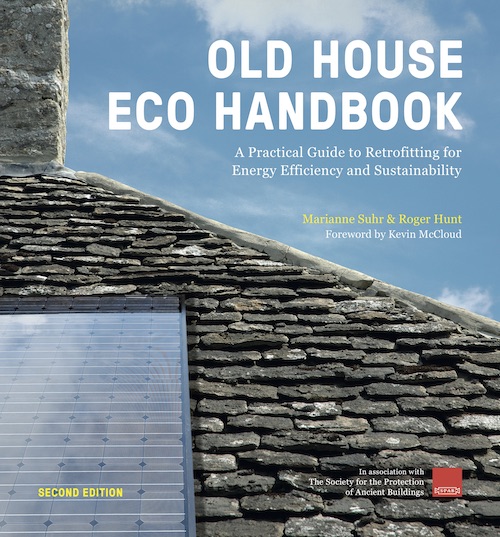
Each time I write a book I say to myself “never again”. This is all very well but when a good idea comes along it’s hard to resist. Towards the end of 2010 I watched as the ink dried on my signature at the bottom of a contract for “a book provisionally entitled ‘The Old House Eco Handbook’”.

Today Old House Eco Handbook – a practical guide to retrofitting for energy-efficiency & sustainability, which I’ve co-authored with Marianne Suhr, is published by Frances Lincoln in association with the Society for the Protection of Ancient Buildings. It serves as a companion volume to our earlier Old House Handbook which was published in October 2008. Amazingly, even that short time ago, thoughts of energy-efficiency and carbon reduction in relation to old houses were only just emerging into mainstream consciousness. How times have changed.

As Kevin McCloud points out in his foreword to Old House Eco Handbook, “There are some 26 million homes in Britain, most of them as well insulated as a rabbit hutch, most of which will still be in existence in 2050. Half a million of them are listed; countless numbers sit in conservation areas and, very roughly, one fifth of our dwellings were built before 1919. Collectively, the buildings we live in are responsible for more or less 26 per cent of Britain’s carbon emissions.”

Making buildings more energy-efficient and sustainable through retrofitting should be seen as an integral part of repair and maintenance. The danger is that, in the rush to be ‘eco’, it’s easy to fall into the trap of failing to ensure compatibility between traditional buildings and modern technologies. This can have far-reaching consequences and the knock-on effects of each action must be considered, from improved airtightness and thermal insulation to the installation of solar panels. If not carefully thought through, these potentially irreversible changes may jeopardise the future of our built heritage.

We have dedicated Old House Eco Handbook to “the generation who will inherit our successes as well as our mistakes”. And there may be mistakes: these buildings were built for a different age and we don’t yet know all the answers when it comes to making them energy efficient, comfortable and sustainable. What we do know is that we have to act. With Old House Eco Handbook we have sought to provide a practical starting point that attempts to tread the delicate path between the needs of our heritage and the needs of tomorrow.

{ 0 comments }

Ancient Monuments Acts panel

Heritage! The Battle For Britain’s Past is a welcome BBC Four series that charts the story of the movement to protect Britain’s heritage, from its early days in the 19th century right through to today.

Produced in partnership with English Heritage, the series is a reminder of the debt of gratitude we owe to the men and women who were instrumental in ensuring the passing of the Ancient Monuments Act in 1913. This recognised for the first time that there are physical remains of the nation’s history which are so special and so significant that the state has a duty to ensure their continued survival.

Of course 1913 was not the beginning. With last week’s programme we were in at the birth of the heritage movement as the long battle to defend the past was fought by figures such as Lubbock, Pitt Rivers, Ruskin and William Morris. It was Morris who, in 1877, founded the Society for the Protection of Ancient Buildings (SPAB) to counteract the highly destructive ‘restoration’ of medieval buildings being practised by many Victorian architects.

The battle was fought in the face of the industrialisation and urbanisation of Britain. What’s more, there was scant understanding of how the built environment represents more than bricks and mortar but memories that are a link to where we come from.

Back in January, when I attended the launch of the programme of events to celebrate 100 years of protecting England’s past, Simon Thurley, chief executive of English Heritage, pointed to the fact that the bill of 1913 was very forward looking. “It was jointly supported by the minister of education and the first commissioner of works. For, as well as making the first list of sites and monuments that would get legal protection – the first listed buildings if you like – they set out to create a great outdoor museum of national history. A collection of monuments that would tell to school children, families, and to adults, the incredible story of the nation, stone by stone.”

In last week’s programme Thurley stated that heritage isn’t just about the past, it’s about the future. How right he is and how important are the words of Morris who said: “We are only trustees for those who come after us.”

Image credit: English Heritage

{ 2 comments }

Attitudes in home buying post image
post in association with Barratt Homes

Some years ago I contributed a chapter to a Reader’s Digest book called The Story of Where You Live. The book paints a fascinating picture of the development of homes, communities and the growing aspirations of those seeking a home. I was reminded of this when the infographic below, that shows the changing attitudes in home buying, arrived from Barratt Homes.

We’ve come a very long way from the poor housing and unhealthy living conditions experienced by much of the population just over a century ago when the Housing and Town Planning Act 1909 came into being.

Although relatively ineffective until after the Second World War, the legislation did prohibit the building of ‘back-to-back’ houses and ‘subterranean’ dwelling units. It also required new homes to be built to certain standards, including the provision of water to each. Importantly it helped define the work of the speculative builders who contributed to the four million houses built in Britain between 1919 and 1939.

Rather than renting, the new middle classes began increasingly to buy their homes with the aid of mortgages. Before the First World War fewer than one in ten houses was owner occupied but the figure had risen to more than three in ten by 1939. Today nearly 65% of people are owner occupiers and housebuilders are doing everything they can to make buying a new home in the UK as painless as possible.

Changing attitudes in home buying

Image credit: Barratt Homes. The first Barratt house, built in the mid-1950s by Laurie Barratt. This led to the foundation of the first Barratt housebuilding company in 1958.

{ 0 comments }

Climate change partnership post image

Your Social Housing in a Changing Climate is a new report from the London Climate Change Partnership. It makes fascinating reading and there were some illuminating presentations at its launch at City Hall earlier this week.

The report focuses on the Colne and Mersea blocks in the London Borough of Dagenham. These two blocks, comprising 200 flats, were scheduled for Decent Homes works and the opportunity arose to adapt them to climate change at the same time. The work was carried out by the contractors United House.

One of the overriding messages at the City Hall event was that there are huge benefits in integrating eco and climate change measures with planned maintenance and refurbishment. This not only saves money but also lessens the disruption to those occupying the properties. What’s more there was general agreement that there is little point implementing Decent Home Standard upgrades without going the extra step. Quite simply, while the scaffolding is up there’s the opportunity to do an eco retrofit relatively easily and economically.

What also came across was that, used appropriately, relatively small sums of money can have a huge impact. Equally importantly, there is a general belief that economies of scale will bring the real dividends both in terms of knowledge transfer and the overall cost of schemes. The frustration is that all too often we’re seeing small, isolated exemplar schemes being repeated time and again without the lessons being passed on from one local authority and group of contractors to another. In addition, there needs to be greater integration through the supply chain and of skills sets.

Stepping beyond the retrofit model to address climate change is vital and the point was made that the danger of flooding exists not just near rivers. At the Colne and Mersea blocks existing drainage was refurbished, flood barriers were fitted to ground floor flats, flood resilient external wall finishes were used and non-return valves installed for soil pipes.

Engagement with residents was another area highlighted. It’s a hugely important aspect of any refurbishment and so is education. The best retrofit in the world can fail to work if the occupier of the property turns off systems or leaves the windows open when it’s inappropriate – the point was made that many people know how to use their mobile phones but not their homes!

At the Colne and Mersea blocks what has been created are essentially new homes. Particularly noteworthy is that, since the retrofit, the previously high turnover of residents has stopped, with no one having asked to move out. Feedback on the project revealed that 89% of residents felt positively about the works.

Climate change and its wider impact is not always appreciated and one useful source of further information is UKCIP which supports adaptation to the unavoidable impacts of a changing climate.

Image credit: United House

{ 0 comments }

  • At the entrance to the lift At the entrance to the lift
  • The Strata tower The Strata tower
  • St Pauls, 111m/365ft the tallest structure in London 1710-1939 St Pauls, 111m/365ft the tallest structure in London 1710-1939
  • 'The Gherkin' 30 St Mary Axe, 180m/590ft with the 'Walkie-Talkie' under construction 'The Gherkin' 30 St Mary Axe, 180m/590ft with the 'Walkie-Talkie' under construction
  • Towards the London 2012 Olympic Park Towards the London 2012 Olympic Park
  • Big Ben clocktower 1858 96m/316ft and the London Eye 1999 135m/443ft, the tallest ferris wheel in the world until 2006 Big Ben clocktower 1858 96m/316ft and the London Eye 1999 135m/443ft, the tallest ferris wheel in the world until 2006
  • Tower Bridge 1894 65m/213ft Tower Bridge 1894 65m/213ft
  • Looking up to The Shard's 'spire' Looking up to The Shard's 'spire'
  • Window cleaning Window cleaning
     

Whatever one may think of The Shard it does provide a unique understanding of London and its architecture. The View From The Shard, as the visitor experience is known, is a slick people moving operation that whisks you via two separate lifts to levels 68-72 without you really realising that you’ve travelled. Only when you arrive do you appreciate that this is the one place in London where nothing blocks the view. It’s also the only place in London where The Shard – the tallest building in Europe at 310m/1016ft – does not pierce the skyline.

The last time I remember anything comparable with the experience of The Shard was when, as a child, I was taken to the top of the what was then the Post Office Tower, now the BT Tower. At 177m/581ft it was, in the 1960s, the tallest building in London.

Yesterday was the first public opening of The View From The Shard and there were a good many architects and other building professionals amongst the visitors. This set me wondering how seeing London from this vantage point might change the way we deal with the architecture of the cityscape below. The roofs of London, like most major cities, are largely neglected, barren places where the paraphernalia required to maintain the mechanical and electrical services of buildings are lodged with little regard for design. Wouldn’t it be wonderful if the legacy of The Shard was a greening of our city roofs or at least a better use of these forgotten acres?

Read my article on the sustainability of tall buildings here.

{ 0 comments }

solar photovoltaic slate tiles from Solar Slate

The solar PV (photovoltaic) industry has had a bumpy ride of late and more than one installer has told me that “domestic solar has fallen off a cliff”. Even so, at the recent launch of the BRE National Solar Centre in St Austell, Cornwall, Greg Barker, Energy and Climate Change Minister, tempered the difficulties of the past with optimism for the future. While acknowledging how difficult recent months have been, he said the industry has come through “this testing period” and has “definitely emerged leaner, wiser and certainly larger”.

Although I wasn’t altogether convinced that everyone in the audience around me agreed with this statement, DECC does state that 1.8GW of solar PV is now deployed and in operation in the UK. This is enough energy to power around 450,000 homes and Barker said: “solar is now rightly recognised as one of DECC’s priority renewable energy technologies and an essential part of our energy future”.

With this in mind the new BRE National Solar Centre, which opens in April, is being established with the aim of helping industry and Government deliver on the solar PV opportunities set out in DECC’s recent 2012 Renewables Roadmap Update. It will also steer the UK’s capacity towards a potential 20GW by 2020. The Centre’s remit is to drive innovation, cost reduction and increased confidence in the marketplace through knowledge generation. It will engage with organisations outside the traditional scope of the industry to ensure that PV is better understood as a technology so its potential can be realised.

A particular focus will be the construction industry and the need to improve its understanding of how to integrate PV products better with buildings. I’d love to see more integrated solar in the residential sector where integration typically involves the use of solar tiles in place of traditional roof tiles. This can help offset costs by reducing the amount spent on building materials and labour that would otherwise be used to construct that part of the roof. But the key benefit for me is that integrated solar can be more successful aesthetically.

Even so, some solar tiles are better than others when it comes to blending in. The most successful I’ve seen for use in a traditional context are those from Solar Slate, a company owned by the RES Group. These have very similar aesthetic properties to roofing slates and are ideal for use in conservation areas, on historic buildings and, of course, for new build projects.

The downside of such products is cost. Although tiles like these might not become significantly cheaper in the immediate future, it’s worth noting that figures from DECC show that the sector as a whole has seen a dramatic reduction in installed costs by up to 50% from 2010-2012.

Image credit: Solar Slate

{ 0 comments }

Wolfgang Feist

The news that Professor Wolfgang Feist – the founder of the Passivhaus Institut – is to be awarded a RIBA honorary fellowship next month confirms both the growing acceptance of the Passivhaus standard in the UK and his contribution to sustainable architecture. It also emphasises the fact that high levels of energy efficiency and good architectural design go hand in hand.

We’re now seeing that Passivhaus is no longer simply for self-build houses in the Grand Designs mould. Recently I wrote a feature for Show House magazine after visiting Octavia Living’s The Greenhauses development, one of London’s largest mixed-tenure schemes being built using the Passivhaus approach.

During his trip to the UK, Feist will be visiting other exemplar Passivhaus sites. These will include Chester-Balmore’s 53 home development in Camden which will be the UK’s largest residential scheme so far to meet the Passivhaus standard. The project is part of Camden’s Community Investment Programme and aims to ensure new-build social housing incorporates energy efficiency at design stage, a key element of Passivhaus certification.

In Ditchingham, South Norfolk, Feist will visit Hastoe’s scheme of 14 homes, the housing association’s second Passivhaus scheme after its award winning Wimbish scheme in Essex. The brief for Ditchingham was to develop affordable dwellings to achieve Code for Sustainable Homes Level 4, Lifetime Homes, Secure by Design and 14 Building for Life points. According to the Passivhaus Trust, the lessons learnt from the Wimbish scheme have been replicated on this project. It is not just an exemplar: this is the first step on the way to making the methodology a mainstream option for those wanting comfortable living environments with low fuel bills. The Ditchingham scheme was completed in September 2012 and is expected to receive it’s Passivhaus certification by the end of January 2013.

As the co-originator of the Passivhaus concept, Feist has given up much of his life to the cause but, as he said to me when I interviewed him a year or so ago: “As long as it is helpful to bring the Passivhaus standard forward I’m not hesitating to do it.”

Image credit: Andy Perrin

{ 0 comments }